Sept. 2026 Intake : Apply now
Master 2 Data Scientist & AI: Sept 2026 Intake
The M2 Data Scientist & AI programme is designed for students holding a Bac+4 or Master’s degree who wish to achieve an expert level in data science and artificial intelligence. This Level 7 (Bac+5) training enables you to design advanced machine learning models and leverage complex industrial data.
Why choose the M2 Data Scientist & AI at AI2?

Expert Content
Advanced AI & MLOps
ML, DL, NLP, LLM

Recognised Degree
Official Certification
RNCP Level 7 & Qualiopi

Professional Approach
Real Data Projects
Industrial Case Studies

Personalised Support
Continuous Coaching
Admission → Employment
Key Information
- Duration: Sept 2026 – May 2027
- Applications: Mar – Jul 2026
- Prerequisites: Master’s or Bac+4 + relevant experience
- Format: Intensive (500h), apprenticeship available
- Recognition: RNCP Level 7 (Master’s equivalent)
- Accessibility: Open to people with disabilities
- Price: €8,000 for initial training
A Training Programme 100% Recognised by the State
This Master’s level training in Data Science and Artificial Intelligence is based on professional certifications registered with the RNCP at Level 7 (Bac+5).

Pedagogical Objectives of the M2 Data Scientist
📊
Advanced Data Pipelines
Build robust pipelines: data quality, traceability, and versioning.
💻
Experimentation
Implement a scientific approach: baselines, iterations, and validation.
🤖
ML & Deep Learning
Develop and optimise high-performance models for tabular and complex data.
🧠
NLP & Generative AI
Understand modern architectures (Transformers), embeddings, and LLM applications.
🚀
MLOps & Deployment
Industrialise models: API deployment, monitoring, and data drift management.
🔐
Ethics & Compliance
Analyse bias, explainability, risks, and comply with EU AI Act and GDPR regulatory requirements.
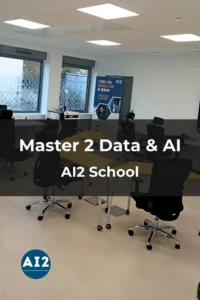
M2 Data Scientist & AI Programme Overview
By joining the M2 Data Scientist & AI, you develop advanced expertise in applied artificial intelligence: designing high-performance models, rigorous experimentation, etc.
- Advanced data pipelines and reliable data preparation
- Scientific experimentation: baselines, iterations, validation
- Advanced Machine Learning and Deep Learning applied to data
- Modern NLP and Generative AI: Transformers, embeddings, semantic search, and LLMs
- MLOps and production deployment: Docker, API, cloud, and monitoring
- Ethics, bias, and compliance: model explainability (SHAP/LIME), responsible AI, and GDPR compliance
- Applied AI project or Final Capstone Project (PFE), with real experimentation and oral defence

Why take the M2 Data Scientist & AI at AI2?
The M2 Data Scientist & AI is designed for students who want to achieve an expert level in data science and applied artificial intelligence.
The goal is no longer just to understand models, but to know how to architect, build, deploy, and govern intelligent systems in real-world professional contexts.
During this training, you will deepen your knowledge of advanced machine learning methods, scientific model experimentation, and the industrialisation of AI solutions.
You will learn to work on complex data problems while integrating the challenges of performance, robustness, ethics, and compliance.
Specifically, you will learn how to:
- Design and optimise advanced machine learning and deep learning models
- Build robust and traceable data pipelines
- Implement a scientific experimentation approach for models
- Develop generative AI and Natural Language Processing (NLP) applications
- Deploy models into production using MLOps practices
- Monitor model performance and data drift over time
- Integrate ethics, explainability, and regulatory compliance into AI projects.

What will you learn in the M2 Data Scientist & AI?
The M2 Data Scientist allows you to reach an expert level in data science and applied artificial intelligence.
The objective of this programme is to teach you how to design high-performance models, rigorously experiment with different approaches, and transform prototypes into truly deployable enterprise solutions.
You will learn to work on complex data problems, optimise model performance, and industrialise AI solutions while integrating the requirements of reliability, traceability, and compliance.
Here is an overview of the skills you will develop:
- Build robust and traceable data pipelines
- Implement a scientific experimentation approach for models
- Design advanced machine learning and deep learning models
- Leverage modern NLP and generative AI (Transformers, LLMs)
- Deploy and maintain models using MLOps practices
- Monitor performance and data drift in production
- Integrate ethics, explainability, and compliance (GDPR/EU AI Act) into AI projects
Why trust AI2 and its M2 Data Scientist & AI?
AI2’s M2 Data Scientist & AI has been designed to train profiles capable of meeting the real needs of companies.
The training is not limited to learning tools or technical libraries: it emphasises model understanding, methodological rigor, and the ability to transform complex data into concrete solutions.
At AI2, the objective is also to support each student in their professional evolution.
The programme combines advanced content, real projects, and pedagogical supervision to prepare students for demanding positions in the fields of data science and artificial intelligence.
This Master’s stands out in particular for:
- A programme focused on real projects and professional case studies (e.g., OREXIA, NOVAPLAS)
- A curriculum covering advanced machine learning, deep learning, and modern AI
- A comprehensive approach including MLOps and production model deployment
- Continuous pedagogical support throughout the training
- A programme based on concrete skills sought after in the market
- A curriculum designed to facilitate students’ professional integration.
FAQ – Master’s 2 in Data Science & AI
Is the M2 Data Scientist & AI equivalent to a Master’s degree?
Yes. It is a French State-recognised RNCP Level 7 certification (Bac+5), equivalent to a Master’s degree across the EU.
Do I need to speak French to apply?
No. The entire programme is 100% taught in English, with no French requirement for admission.
What are the admission requirements for this M2 programme?
You need a Master’s degree (or equivalent) in a technical field and basic skills in programming, statistics, and databases.
How long is the M2 Data Scientist & AI programme?
The programme lasts 1 year, from September to May, including a final capstone project.
What career opportunities after this programme?
Graduates access roles like Data Scientist, AI Engineer, MLOps Engineer, or AI Consultant in high-demand industries.
What makes AI2 different from other data science programmes?
AI2 focuses on real-world projects, MLOps, industrial AI, and portfolio-based learning assessed by industry experts.
What is the best Data Scientist training in AI?
Choosing the best training often depends on several criteria: pedagogical quality, technical skills taught, and the programme’s ability to prepare students for real data science jobs.
An M2 data scientist should go beyond theory to teach how to architect, build, and deploy artificial intelligence models in professional contexts.
A solid training programme like an M2 data scientist in artificial intelligence must also integrate the learning of data pipelines, experimentation methods, and model deployment practices.
The goal is to train specialists capable of transforming data into concrete solutions for companies.
Where should I train to become an AI Data Scientist?
Today, several schools and universities offer training in data science and artificial intelligence.
However, not all offer the same level of support or the same orientation towards real-world jobs.
An M2 data scientist must allow students to work on real projects and gain practical experience with AI systems.
Certain programmes, such as an M2 data scientist in artificial intelligence, combine advanced technical learning with practical cases inspired by corporate challenges.
This approach enables students to develop directly applicable skills in the fields of machine learning, deep learning, and applied AI.
M2 Data Scientist or Master 2: what is the difference?
A university Master 2 is generally oriented towards academic research and theoretical depth.
Students develop solid analytical skills and can continue towards a PhD or scientific work in the field of data science or artificial intelligence.
Conversely, an M2 data scientist in artificial intelligence is often designed to prepare students more directly for data and AI careers.
In this type of training, students work on concrete projects, learn to deploy models, and develop the technical skills required to work as a data scientist, machine learning engineer, or artificial intelligence expert.
Still hesitating?
Ask all your questions during a free call with our team. We are here to guide you in your choice and help you make the best decision.
Need a guide?